01
Manual checks
Buyers search contract history, ask Procurement directly, or wait for Procurement to issue a manual verification.
GC Supplier Trust
GC Supplier Trust lets suppliers embed a GC supplier badge that anyone can verify in one click. Procurement signs one snapshot of supplier-status data, and suppliers generate their own credentials from it, so Procurement never has to manually issue credentials.
The gap
01
Buyers search contract history, ask Procurement directly, or wait for Procurement to issue a manual verification.
02
A “GC supplier” logo on a website is just an image. Anyone can copy it onto a look-alike site.
03
Procurement platforms and AI agents have nothing machine-readable to check.
04
A conventional credential programme would have PSPC enrol and issue supplier by supplier.
How it works
Self-service: zero PSPC touchpoints per credential
Copy-proof: fails verification on any other domain
Quantum-ready: Ed25519 + ML-DSA-65 (NIST FIPS 204)
01
On a set schedule, supplier-status data, minus suppliers on the ineligibility list, becomes a Merkle tree. Procurement automatically signs its root with classical and post-quantum signatures.
02
In a self-service dashboard, the supplier finds its own record and gets a credential holding its inclusion proof without PSPC involvement.
03
The supplier adds the script tag to their website. The credential is verified against and bound to that domain.
04
Click the badge, scan its QR code, call the API or ask an AI agent. The checks run in the verifier’s browser, with no issuer server in the path.
Video demo
Features
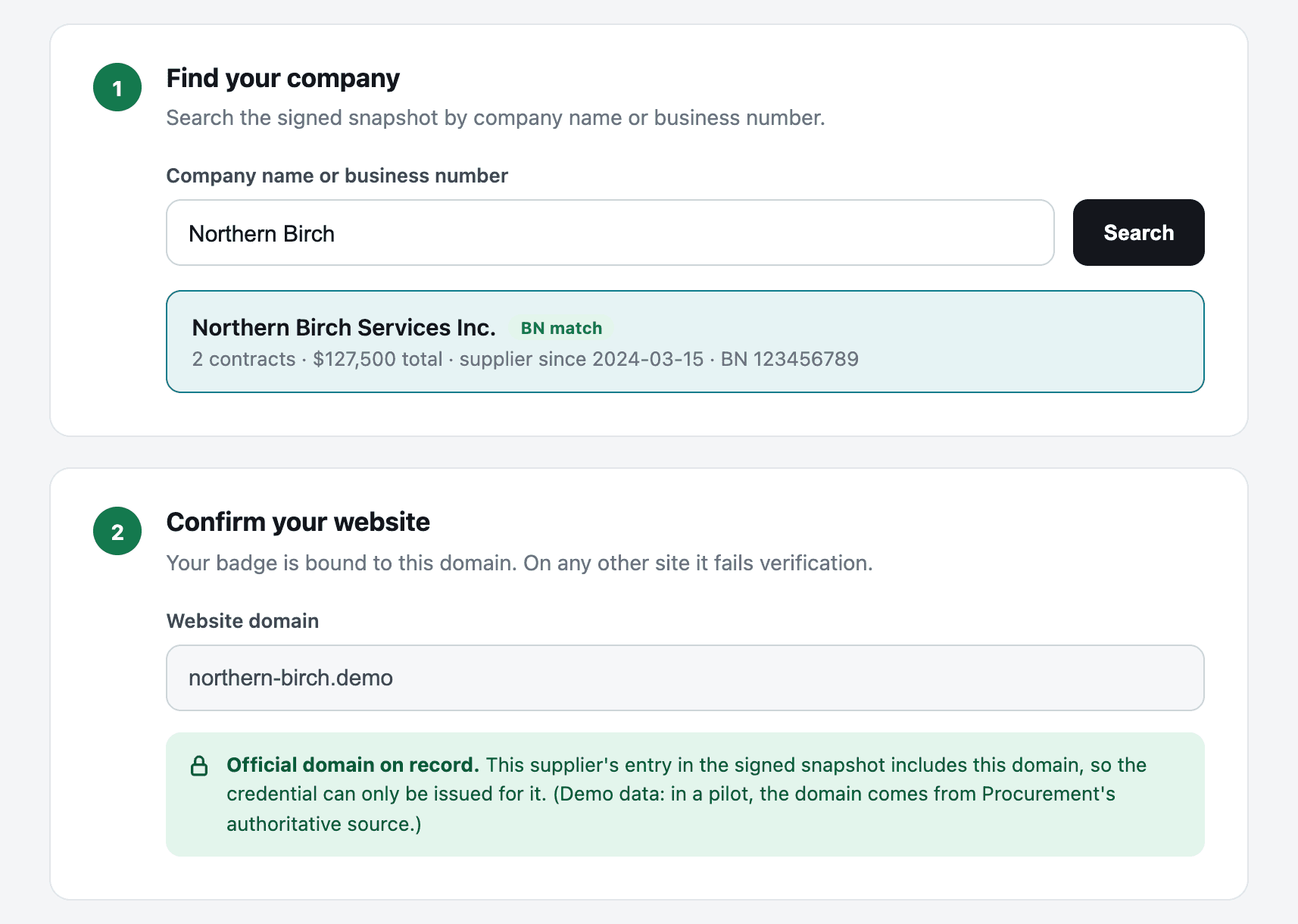
A supplier opens the self-service dashboard and searches by company name or business number. The dashboard reads the snapshot Procurement signed, so a supplier can only find a record that is already there. No account needed.
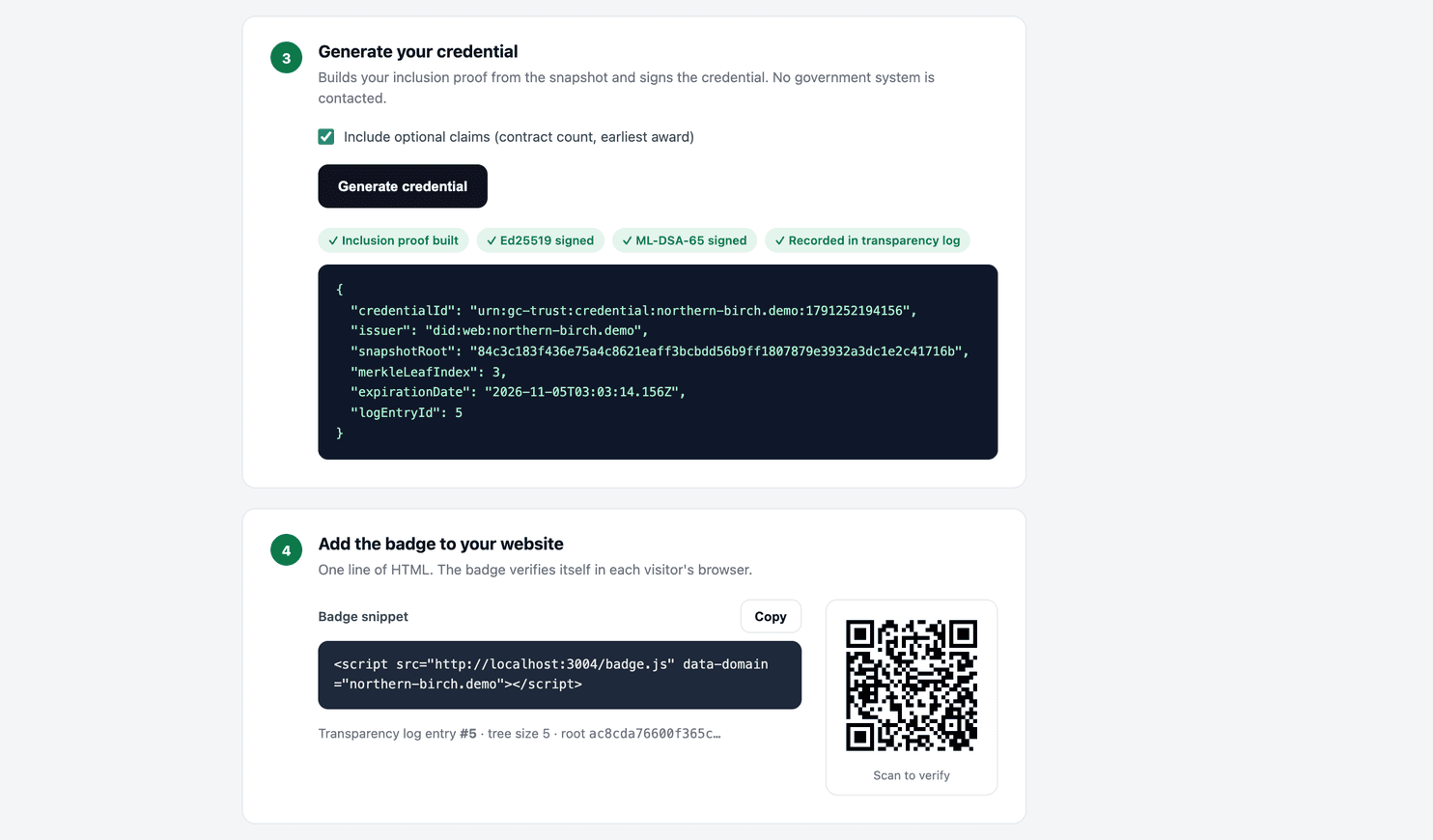
The dashboard builds the supplier’s inclusion proof from the snapshot, packages it as a signed credential, and records it in a public transparency log. The supplier gets one line of HTML for its website and a QR code for printed material.
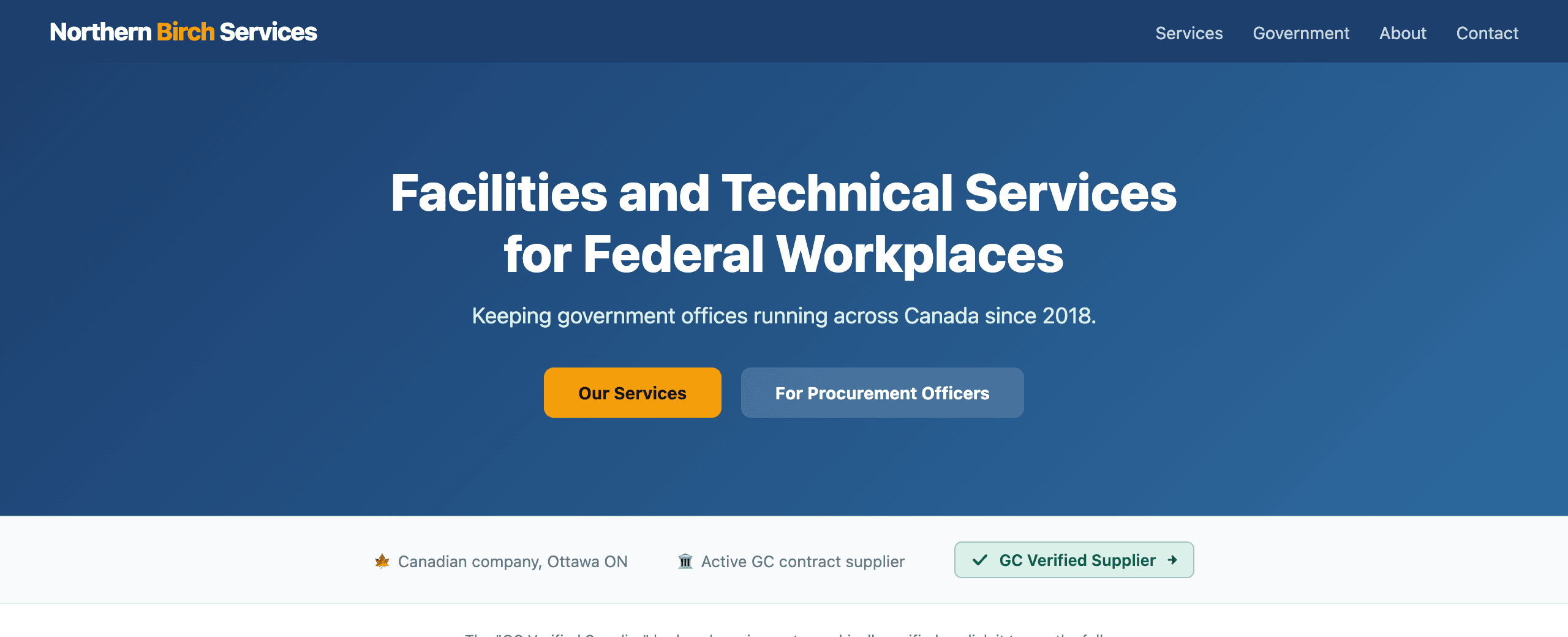
When a visitor opens the supplier’s site, the badge checks its credential right in the visitor’s browser and shows “GC Verified Supplier” only if every check passes. No server call to an issuer is needed to decide.
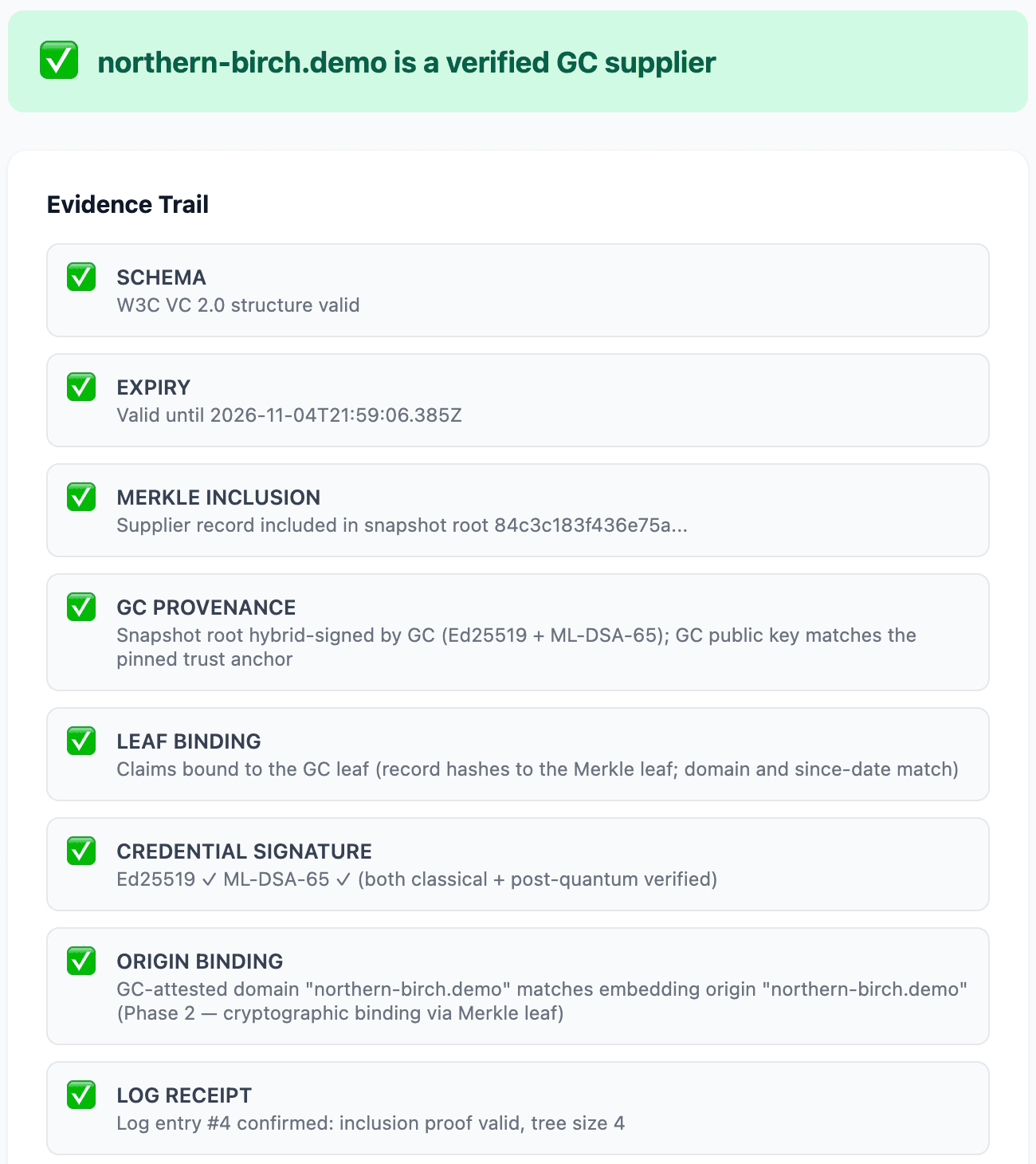
Clicking the badge opens the evidence trail: eight checks that a buyer or procurement officer can read for themselves.
Because each credential is bound to the supplier’s official domain, copying the badge onto a look-alike website turns it red. The verifier names the domain the credential belongs to, so the mismatch is obvious.
On the supplier’s own domain: verified

The same badge copied onto a look-alike site: rejected

The same checks are available as a Model Context Protocol tool, so an AI agent gets a structured verdict and the full evidence trail instead of scraping a web page.
{
  "verdict": "VERIFIED",
  "domain": "northern-birch.demo",
  "gcSupplierSince": "2024-03-15",
  "latencyMs": 130,
  "evidenceTrail": [ 8 checks, all passed ]
}
What’s new
| Dimension | Traditional solutions | GC Supplier Trust |
|---|---|---|
| Issuance | An issuer enrols and signs each subject | Procurement signs one snapshot and suppliers serve themselves, so each credential costs effectively nothing |
| Verification | Depends on issuer, status-list or registry servers | Runs in the browser or AI agent, with no issuer server in the path |
| Copy protection | Logos and portable credentials can be re-shown elsewhere | Bound to the supplier’s domain, so a copied badge fails |
| Cryptography | Classical signatures | Hybrid Ed25519 and NIST FIPS 204 ML-DSA-65 signatures, and both must verify |
| AI agents | No procurement-specific interface | MCP tool returns a structured, machine-readable verdict |
Traditional solutions
An issuer enrols and signs each subject
GC Supplier Trust
Procurement signs one snapshot and suppliers serve themselves, so each credential costs effectively nothing
Traditional solutions
Depends on issuer, status-list or registry servers
GC Supplier Trust
Runs in the browser or AI agent, with no issuer server in the path
Traditional solutions
Logos and portable credentials can be re-shown elsewhere
GC Supplier Trust
Bound to the supplier’s domain, so a copied badge fails
Traditional solutions
Classical signatures
GC Supplier Trust
Hybrid Ed25519 and NIST FIPS 204 ML-DSA-65 signatures, and both must verify
Traditional solutions
No procurement-specific interface
GC Supplier Trust
MCP tool returns a structured, machine-readable verdict
Federal departments and agencies can test it through Innovative Solutions Canada. For a live demo or any questions, please contact 1280 Labs at info@1280labs.ca.
Conditionally qualified under the Innovative Solutions Canada Testing Stream (EN578-26ISC1, TS13) for supplier verification and decentralized credentialing.

